Original article
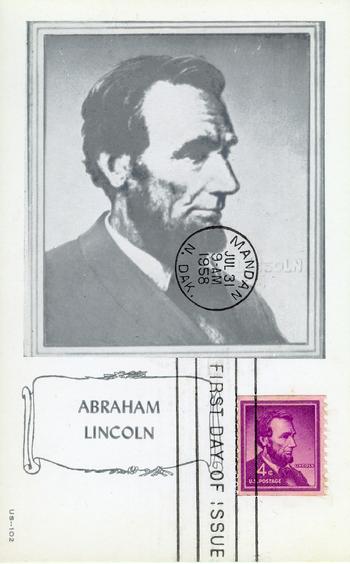
The US Postal Service 4-cent Lincoln coil stamp and associated first day covers were issued at the Mandan post office on July 31, 1958. The "4-cent Lincoln," as the name implies, features President Abraham Lincoln. This stamp was issued to accommodate the August 1, 1958 increase in first-class postage rate after twenty-six years at three cents. Originally issue on November 16, 1954, this red-violet stamp features Lincoln’s likeness inspired by a portrait by Douglas Volk. First-class postage remained four cents through January 6, 1963, and this stamp was the workhorse during that period. The new Lincoln stamp replaced the three-cent purple "Statue of Liberty-In God We Trust" stamp which previously filled the role. A "First Day Cover" (FDC) features unique artwork known as cachets applied to envelopes affixed with the new postage stamp but only on the date of first of issue and only the select post office(s). The FDCs for the roll coil stamps were issued at the Mandan post office, which had been singled out for the honor due to its proximity of Fort Abraham Lincoln. FDCs for the stamp in booklet panes were issued on the same date at Wheeling, West Virginia.
Abraham Lincoln currently ranks third as the subject of a US postage stamp. Only George Washington and Thomas Jefferson have appeared on more stamp issues.
These postage FDCs are collected nationally. At least twenty first-day-cover cachets were issued as well as a blank envelope cancelled on that date. Examples are presented above.Mrs. Margaret (George H.) Bingenheimer, Mrs. Fanny (John L.) Bowers and Mrs. Anne (Lyman N.) Cary, all early Mandan pioneers and wives of early day prominent businessmen, were given the honor of purchasing the first new four-cent Lincoln coil stamp. In the weeks before the release, over 100,000 letters were received by the Mandan Post Office for first day cancellations. According to Mandan postmaster J. J. Murray, more than $60,000 (over $450,000 in 2010 adjusted for interest) worth of the new 500-stamp rolls were on hand for the first day of its release. In addition to the 100,000 letters, 50,000 envelopes were cancelled for stamp dealers across the country and around the world. First day cachets were affixed to envelopes from France, Australia and the Philippines. The permenant staff was supplemented with 18 temporary workers to assist with the first day issues.
Copy-edited article
The U.S. Post Office Department issued the four-cent Lincoln coil stamp and its associated first-day covers at the Mandan post office on July 31, 1958. The stamp features President Abraham Lincoln and was issued to accommodate the increase in the first-class postage rate from three to four cents on August 1, 1958—the first increase in 26 years. Originally issued on November 16, 1954, the red-violet design features Lincoln's likeness based on a portrait by Douglas Volk. First-class postage remained four cents through January 6, 1963, and the stamp was widely used during that period. It replaced the three-cent purple "Statue of Liberty—In God We Trust" stamp.
A first-day cover (FDC) is an envelope bearing a newly issued stamp, a cancellation from its first day of issue, and often unique artwork known as a cachet. The FDCs for rolls of the coil stamp were issued at the Mandan post office, selected because of its proximity to Fort Abraham Lincoln. Covers for stamps issued in booklet panes were released the same day in Wheeling, West Virginia.
Abraham Lincoln currently ranks third among subjects depicted on U.S. postage stamps. Only George Washington and Thomas Jefferson have appeared on more issues.
First-day covers are collected nationally. At least 20 cacheted covers and one blank envelope were canceled in Mandan that day. Examples appear above.
Mrs. Margaret (George H.) Bingenheimer, Mrs. Fanny (John L.) Bowers, and Mrs. Anne (Lyman N.) Cary, all early Mandan pioneers and wives of prominent early businessmen, were given the honor of purchasing the first new four-cent Lincoln coil stamps.
In the weeks before the release, the Mandan Post Office received more than 100,000 letters for first-day cancellations. According to Mandan postmaster J. J. Murray, more than $60,000 (about $670,000 in 2025 dollars) worth of the new 500-stamp rolls were on hand for the first day of issue. In addition to the 100,000 letters, 50,000 envelopes were canceled for stamp dealers across the country and around the world. First-day cachets were affixed to envelopes from France, Australia, and the Philippines. The permanent staff was supplemented by 18 temporary workers to assist with the first-day issues.