Original article
1960
Mandan experienced a resurgence of civic service, with a record number of fraternal and service clubs and members, evident in the number and size of New Year parties at the downtown Elks building, the Moose Home, Knights of Columbus (KC) Hall, American Legion Hall, Veterans of Foreign Wars Club, Eagles Club. The Revelers Club celebrated at the Mandan Country Club. After several prior attempts, the citizens of Mandan in a margin of almost two to one approved the move to Central Standard Time on a year round basis starting May 15.A record-breaking 74⁰F on March 28 hastened the breakup of the ice on the Missouri River on April 5. A huge ice jam on the Heart River resulted in water backing up over Highway 10 to a depth of two feet, forcing the closure of floodgates and stopping all traffic to Bismarck. With more than 400 Republican conventioners staying in Mandan, the Northern Pacific Railway came to the rescue by adding a half dozen special commuter trains between Mandan and Bismarck to transport the delegates to and from the convention center.A new gymnasium and more classrooms were added to Mandan's Senior High School building's north side. The gym in the $290,000 structure seats more than 2,000 people for basketball games and includes storage areas and complete athletic facilities including showers, lockers, etc.
1961
With the stay-at-home mom the norm, Morton County boasted no less than five homemakers clubs including the Rock Haven Homakers Club, Almont Homemakers Club, Fort McKeen Club, Big Bend Homemakers Club and the Highland Homemakers Club.
1962
Mandan elected its first woman to the City Commission in April. Mrs. Dolores Pierce joined incumbent Mr. George Schantz who successfully won re-election.
1963

Six community civil defense shelters were established in Morton County, including four within Mandan's city limits in April. The fallout shelters were established in the basement of the Lewis and Clark Hotel, the Mandan Creamery, St. Joseph School, and the Courthouse. Black Motor Sales in New Salem and Hebron Motors, Inc. of Hebron hosted sites for rural areas of the county. Each shelter would hold up to 1,100 people. Cartons of rations, sanitary and medical supplies were stored there, courtesy of the Department of Defense.
1964
Direct Distance Dialing came to Mandan in July. A $1.5 million upgrade to the Northwestern Bell Telephone Company brought 7-number dialing to the city, the month after the same service started in Bismarck. The system replaced three and four number telephone numbers in use prior to that time. "663" was the first exchange prefix used in Mandan.
1965
In February, firefighters battled for 3 hours to extinguish a major fire at the site of the historical Merchant Hotel located at 106 East Main St. The fire started in the basement, and quickly spread to both adjacent commercial buildings due to high winds. At the time, its was home to Ray's Bootery, owned and operated by Ray Mosbrucker. Other involved businesses included Seb's Shoe Repair and the vacant / former Friesz Grocery building.
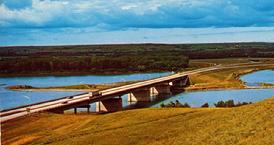
Interstate 94 was completed including the second river crossing via the Grant Marsh Bridge. Like in most North Dakota cities, traffic was diverted off Main Street / ND Highway 10. The downtown central business district on both sides of the river would eventually be suffer with the migration of retail stores to stand alone shopping centers or commerical areas along interstate routes.
1966
North Dakota experienced the "Storm of the Century" from March 2 to March 4 when a late spring blizzard struck the state. Over 22 inches of snow fell on the area. The Mandan Pioneer ran a special souvenir edition of the event. '66 Blizzard Souvenir Edition
The era of railroad steam engines took another step into the past when demolition experts blasted down the 165-foot high chimney in the Mandan railyards. The reinforced concrete chimney built for steam engine boiler drafting in 1928 by the Heine Chimney Company was toppled with dynamite by the same company.
1967
Work was completed in January on the relocation of the Mandan to Flasher main line Northern Pacific railroad track. The $10 million (77.3 million 2016$) project included the installation of over 40 miles of track by two work teams, with the completion point near Fallon. Work was started on the project in September 1965. The US Army Corps of Engineers initiated to project to move it away impacts of Lake Oahe. The old track which meandered along the Cannonball and Missouri River for 67 miles will now be shorter by 22 miles. The original track was abandoned that spring.

In August, the Mandan City Commission voted to support an ambulance service for the city by joining in a three-party contract with the Bismarck Ambulance Service to provide an ambulance and driver for the city of Mandan. Current “ambulance” operators, Warren Buehler of Buehler Funeral Home and Hector Hoenig of Hoenig Funeral Home had announced earlier this year their intention to suspend their services.
Suffering through one of the most severe droughts in recent history, local farmers saw crop yields drop by about a third compared to typical yields.
1969
In October 1969, Cass-Clay Creameries of Fargo purchased the operation of Foremost Dairies in Mandan. The sale, for an undisclosed sum, was prompted by the far distances from their other operations in the southwest and west coast of the nation.
Copy-edited article
1960
Mandan experienced a resurgence in civic service, with record numbers of fraternal and service clubs and members. This was evident in the number and size of New Year's parties at the downtown Elks Building, Moose Home, Knights of Columbus Hall, American Legion Hall, Veterans of Foreign Wars Club, and Eagles Club. The Revelers Club celebrated at the Mandan Country Club.
After several earlier attempts, Mandan residents approved a move to year-round Central Standard Time by a margin of almost two to one, effective May 15.
A record temperature of 74°F on March 28 hastened the breakup of Missouri River ice on April 5. A huge ice jam on the Heart River backed water over Highway 10 to a depth of 2 feet, forcing the floodgates to close and stopping all traffic to Bismarck. More than 400 Republican convention delegates were staying in Mandan, so the Northern Pacific Railway added six special commuter trains between Mandan and Bismarck to transport them to and from the convention center.
A new gymnasium and additional classrooms were built on the north side of Mandan Senior High School. The gym in the $290,000 addition seated more than 2,000 people for basketball games and included storage and complete athletic facilities, including showers and lockers.
1961
At a time when stay-at-home mothers were common, Morton County had at least five homemakers clubs: the Rock Haven Homemakers Club, Almont Homemakers Club, Fort McKeen Club, Big Bend Homemakers Club, and Highland Homemakers Club.
1962
In April, Mandan elected its first woman to the City Commission. Dolores Pierce joined incumbent George Schantz, who won reelection.
1963
Six community civil defense shelters were established in Morton County in April, including four within Mandan's city limits. The Mandan fallout shelters were in the basements of the Lewis and Clark Hotel, Mandan Creamery, St. Joseph School, and the courthouse. Black Motor Sales in New Salem and Hebron Motors Inc. in Hebron hosted shelters for rural areas of the county. Each could hold as many as 1,100 people. The Department of Defense supplied cartons of rations and sanitation and medical supplies.
1964
Direct Distance Dialing came to Mandan in July. A $1.5 million Northwestern Bell Telephone Company upgrade brought seven-digit dialing to the city one month after the same service began in Bismarck. The system replaced the three- and four-digit telephone numbers previously in use. "663" was Mandan's first exchange prefix.
1965
In February, firefighters battled for three hours to extinguish a major fire at the historic Merchant Hotel site at 106 East Main Street. The fire began in the basement and, driven by high winds, quickly spread to both adjacent commercial buildings. At the time, the former hotel housed Ray's Bootery, owned and operated by Ray Mosbrucker. Other affected properties included Seb's Shoe Repair and the vacant former Friesz Grocery building.
Interstate 94 was completed, including a second river crossing on the Grant Marsh Bridge. As in many North Dakota cities, traffic was diverted from Main Street and North Dakota Highway 10. The downtown business districts on both sides of the river eventually suffered as retail stores migrated to stand-alone shopping centers and commercial areas along interstate routes.
1966
North Dakota experienced the "Storm of the Century" from March 2 through March 4, when a late-winter blizzard struck the state. More than 22 inches of snow fell in the area. The Mandan Pioneer published a special souvenir edition about the event.
The era of railroad steam engines receded further into the past when demolition experts blasted down a 165-foot chimney in the Mandan rail yards. The Heine Chimney Company had built the reinforced-concrete stack in 1928 to provide draft for steam-engine boilers and returned to topple it with dynamite.
1967
Work was completed in January on the relocation of the Northern Pacific's Mandan-to-Flasher main line. The $10,000,000 (about $96,557,000 in 2025 dollars) project involved more than 40 miles of new track installed by two work crews, which met near Fallon. Construction had begun in September 1965. The U.S. Army Corps of Engineers initiated the project to move the line away from the effects of Lake Oahe. The new route was 22 miles shorter than the old track, which meandered for 67 miles along the Cannonball and Missouri rivers. The original line was abandoned that spring.
In August, the Mandan City Commission voted to support a city ambulance service through a three-party contract with the Bismarck Ambulance Service, which would provide Mandan with an ambulance and driver. Existing ambulance operators Warren Buehler of Buehler Funeral Home and Hector Hoenig of Hoenig Funeral Home had announced earlier that year that they intended to discontinue their services.
During one of the most severe droughts in recent history, local farmers saw crop yields fall by about one-third.
1969
In October 1969, Cass-Clay Creameries of Fargo purchased the Foremost Dairies operation in Mandan. Foremost sold the plant for an undisclosed sum because of its distance from the company's other operations in the Southwest and on the West Coast.