Original article
Havana Club, a basement nightclub for years, built its success on its wonderful reputation for food, service, ambiance. Like the Hotel McKenzie/Patterson Hotel in Bismarck, it was a place where many a political, business (legal and otherwise!) deals took place. Leo Guon left the business to his son when he died in November 1961, but he was not as enthusiastic about the food and service industry as his father. Lacking much oversite, the business' reputation deteriorated. Finances became tight, FICA taxes were not paid and the IRS closed the club in July of 1964.
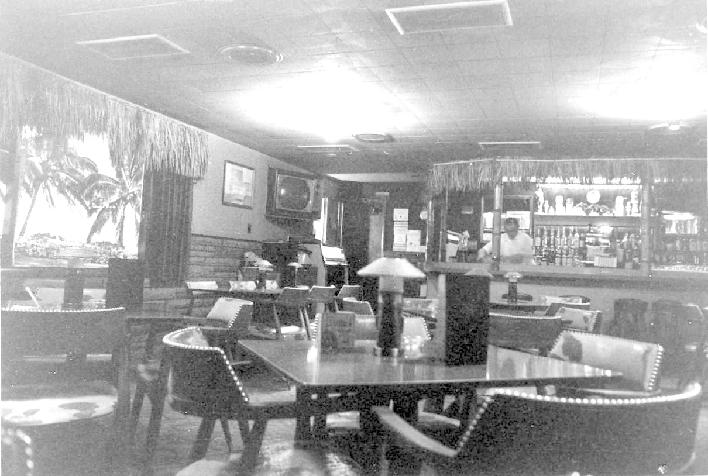
Havana Club Interior - Photo Courtesy of Esther Davis
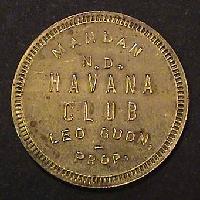
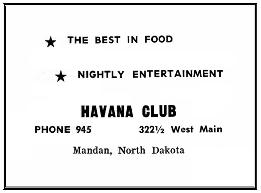
1956 Ad
Barry and Esther Davis bought the Havana Club and reopened it on September 14, 1964. They had been approached by interested parties, including creditors, who wished the establishment to remain open and assisted with the deal's financing. Barry Davis had provided muscial entertainment at the site for years, and Esther had worked as a food hostess at another local nightclub.
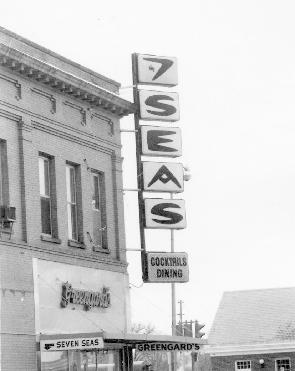
With its prior decline, the Davises needed to put some distance between the Havana Club's tarnished reputation and its new ownership, management and operation. They remodeled the interior including the addition of a miniature waterfall, fish tanks and koi (e.g. broaded carp) to the waterfall's pool. They also ran a contest to rename the club and that is how it became the Seven Seas. Aided by area friends to helped to promote the club, patrons slowly returned. Its warm atmosphere also attacted area businesses to host luncheon meetings and other gatherings there. These same businessmen and professional clientle would returned in the evenings. Friday and Saturday evening dinners eventually rose from 10-12 a night to 165-175 over a 4 year period. Photo Courtesy of Esther Davis
The biggest event held at the club was the annual New Year's Eve parties. While the capacity crowds would always bring a hectic pace, the owners shared a champagne toast with the kichen and service crews at midnight to acknowledge their hard work that evening. The operation remained at its downtown location until the building was destroyed by fire in 1970.
The Society would like to thank Esther Davis for contributing to this feature article.
Copy-edited article
The Havana Club, a longtime basement nightclub, built its success on a reputation for excellent food, service, and atmosphere. Like Bismarck's McKenzie—later Patterson—Hotel, it was a place where many political and business deals, both legal and otherwise, took place. Leo Guon left the business to his son when he died in November 1961, but the son was less enthusiastic about the food-service industry. Without close oversight, the club's reputation deteriorated. Finances tightened, federal payroll taxes went unpaid, and the Internal Revenue Service closed the club in July 1964.
Barry and Esther Davis bought the Havana Club and reopened it September 14, 1964. Interested parties, including creditors who wanted the establishment to remain open, approached the couple and helped finance the purchase. Barry had provided musical entertainment at the club for years, and Esther had worked as a food hostess at another local nightclub.
The Davises needed to distance the business from the Havana Club's declining reputation. They remodeled the interior, adding a miniature waterfall, fish tanks, and koi—brocaded carp—to the waterfall's pool. A contest produced a new name: the Seven Seas.
Area friends helped promote the club, and patrons slowly returned. Its warm atmosphere attracted area businesses for luncheon meetings and other gatherings, and many of the same business and professional customers returned in the evenings. Over four years, Friday and Saturday dinner service grew from 10–12 meals a night to 165–175.
The club's largest events were its annual New Year's Eve parties. Despite the hectic pace of the capacity crowds, the owners shared a midnight champagne toast with the kitchen and service crews in recognition of their work. The Seven Seas remained downtown until fire destroyed the building in 1970.
The Society thanks Esther Davis for contributing to this feature article.