Original article
Fredrick and Robert Hager from St. Paul MN opened the InterOcean Hotel across Main Street from the new Northern Pacific (NP) Railroad Depot. The Hager Brothers had prospered as a result of the real estate speculation and the lumber business. Viewing the impacts of the March 1881 flood with binoculars from the eastern bluffs of the Missouri River, Fredrick saw an opportunity. He hurried to take a train back to St. Paul to visit NP Railway Land Office and purchased half of the lots in the western part of the city. Fredrick returned with railcars of lumber and brothers Robert and Joseph to join the elder Hager in the lumber business at a new site on Mandan's west Main Street. Purchasing properties for just over $60 a lot, they would resell them within two years for between $500 and $1500 each after the NP Railway located their new passenger depot.
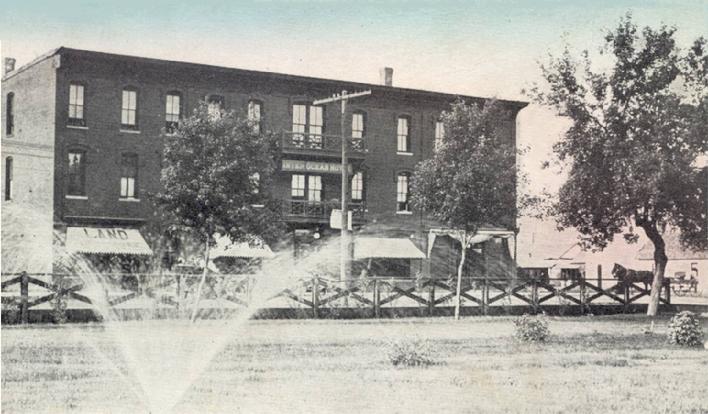
Their new hotel, located at the northwest corner of Dilworth Avenue (today's 3rd Avenue NW) and Main Street, was built and furnished at the cost of $86,000 ($4.9 million in 2024$) and was the first three story building in the city and opened in April 1882. Art Kredler was its first manager, a position he would retain until forced to resign in February 1926 due to failing health. The Inter-Ocean Hotel was among a number of hotels that were established in that area of town. The hotel was a magnificent three-story brick structure, located immediately opposite the new $12,000 Northern Pacific Railway passenger depot. The opening coincided with the completion of the NPRy railroad bridge across the Missouri River.The Hager Brothers would invite other capitalists of the day to invest in the booming city of Mandan. Marion A. Vinton of New York and Tilden R. Selmes of St. Paul were among the investors who spearheaded the construction of brick stores along west Main Street.
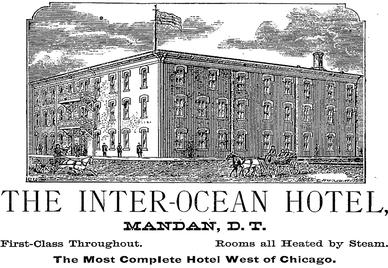
"The hotel is fitted up throughout in most exquisite taste and is absolutely perfect and complete in all its details. The management which has revolved upon Mr. John Hager has been fully in keeping with the house superlatively first class and the happy combination has made the 'The Inter-Ocean' the most powerful advertising medium of Mandan." Ad from Daily Pioneer "Immigrant Edition No. 2" 1883
Among the many exclusive features of this hotel, one of the most noteworthy was its indoor plumbing system which was a very modern feature for Dakota hotels of the time. The building also boasted a central steam heating system utilizing an Osborne's patented steam heating apparatus, placed in this building at a cost of $12,000 (390,000 2024$). Each room was furnished with radiator which can be regulated to suit by each individual guest. The furniture throughout the hotel was elegant, comparable to the finest hotels in New York. And took pride that the dining room was staffed with "colored" waiters. The local newspaper claimed in 1883 the citizens of Mandan were entitled to "great pride ... at this superb carevansary and its great elegance is best understood when it is stated that such distinguished parties as Henry Villard, Rufus Hatch, Sir John Rose and others who enjoyed the hospitalities of this hotel during the past summer unhestatingly and frankly pronounce it the best and most complete hotel west of Chicago." Sitting Bull would attend a musical play there.
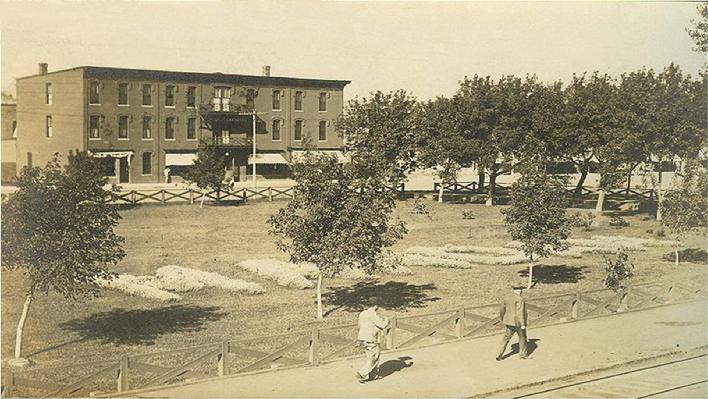
1908 Inter-Ocean Hotel and NP Park
In 1896, the dining facilities were relocated into a modern facility on the second floor in the previous east parlor. The kitchen and pantries remained on the first floor. Meals were lifted to the second floor by a new dumb waiter system. The property would be purchased in 1916 by R.B. Hanna and renamed the Lewis and Clark Hotel. The building was torn down the following year and a new hotel built on the site which opened in January 1918, which remains in place today.
Copy-edited article
Frederick Hager and Robert Hager of St. Paul opened the InterOcean Hotel across Main Street from the new Northern Pacific Railway depot. The Hager brothers had prospered through real-estate speculation and the lumber business.
While observing the March 1881 flood through binoculars from the bluffs east of the Missouri River, Frederick saw an opportunity. He took a train to St. Paul, visited the Northern Pacific Railway Land Office, and purchased half the lots in western Mandan. Frederick returned with railcars of lumber and his brothers Robert and Joseph, who joined him in the lumber business on West Main Street. The brothers bought properties for slightly more than $60 per lot and, after Northern Pacific located its passenger depot nearby, resold them within two years for $500 to $1,500 each.
Their hotel stood at the northwest corner of Dilworth Avenue—now Third Avenue Northwest—and Main Street. Built and furnished for $86,000 (about $2,869,000 in 2025 dollars), it was Mandan's first three-story building and opened in April 1882. Art Kredler was its first manager and remained in the position until failing health forced his resignation in February 1926.
The magnificent three-story brick hotel stood directly opposite the new $12,000 (about $400,000 in 2025 dollars) Northern Pacific passenger depot. Its opening coincided with completion of the railroad bridge across the Missouri River. The Hagers encouraged other investors to join Mandan's boom. Marion A. Vinton of New York and Tilden R. Selmes of St. Paul helped finance brick stores along West Main Street.
“The hotel is fitted up throughout in most exquisite taste and is absolutely perfect and complete in all its details. The management which has revolved upon Mr. John Hager has been fully in keeping with the house superlatively first class and the happy combination has made the ‘The Inter-Ocean’ the most powerful advertising medium of Mandan.”
—Advertisement in the Daily Pioneer, “Immigrant Edition No. 2,” 1883
Among the hotel's most notable features was indoor plumbing, then uncommon in Dakota hotels. It also had central steam heat supplied by an Osborne patented apparatus installed for $12,000 (about $400,000 in 2025 dollars). Each guest could regulate the radiator in their room. The hotel's furnishings were compared with those in New York's finest hotels, and the management took pride in advertising a dining-room staff of “colored” waiters.
In 1883, a local newspaper reported that prominent guests including Henry Villard, Rufus Hatch, and Sir John Rose had called it the finest and most complete hotel west of Chicago. Sitting Bull attended a musical play there.
In 1896, the hotel moved its dining room to the former east parlor on the second floor, while the kitchen and pantries remained on the first. A new dumbwaiter carried meals upstairs.
R. B. Hanna purchased the property in 1916 and renamed it the Lewis and Clark Hotel. The building was demolished the following year. A new Lewis and Clark Hotel, which remains standing, opened on the site in January 1918.