Original article
The Merchant's Hotel was one of the first hotels in Mandan which opened for business in January 1880 at 112 East Main Street. Built by Henry & Philomena Yunck, the hotel continued to operate until 1920. It was situated in a favorable location, between the early railroad depot and the Emerson Institute (later expanded to become the "Opera House".) After the railroad moved into a new larger depot three blocks west in 1883, the hotel serviced primarily railroad workers and immigrants.
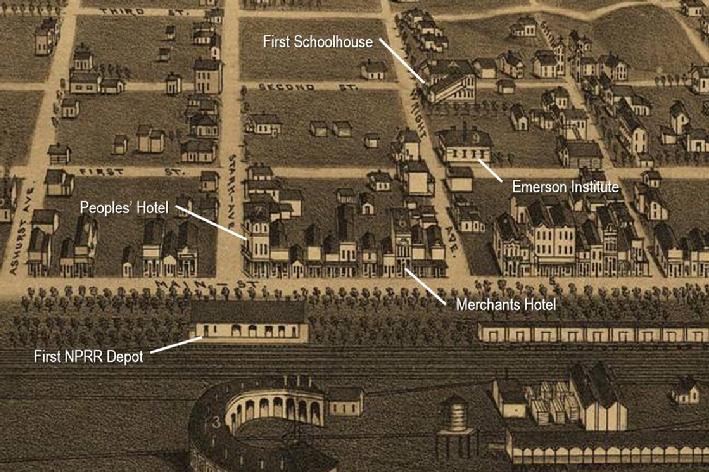
Exerpt from 1883 Stoner "Birds Eye View of Mandan"
Henry and Philomena Yunck with 2-year old daughter Marie moved to Bismarck, DT in 1878 and resided at the steamboat landing while operating a boarding house. Philomena cooked meals for the bridge building crew and Henry worked as a laborer on the landing. In 1879, the couple decided to move their family, now with the addition of son Joseph, across the river to Mandan. In January 1880, they celebrated the grand opening of the hotel. Philomena was well known for her delicious meals. Breakfast included hotcakes, sausage or bacon with fruit, with all the coffee one could drink for only 10¢. Dinners were no more than 65¢. She cooked meals for the Marquis de Mores while he was being jailed behind the hotel, awaiting trial for murder. Chief Si Tanka (aka Chief Spotted Elk, also referred to as Big Foot) was a frequent guest at the Yunck's for dinner during his travels back and forth from Cannonball. Theodore Roosevelt was also a familiar figure at the hotel in the early 1880s for stops to go duck hunting with close friends during trips between Bismarck and Medora. Grover Cleveland also appears in the 1884 hotel registry. Unregistered guests included countless immigrants relocating to Dakota Territory. The Yuncks frequently offered them free meals and lodging; to a point where a separate building was erected on the back portion of the lot expressly for the purpose.
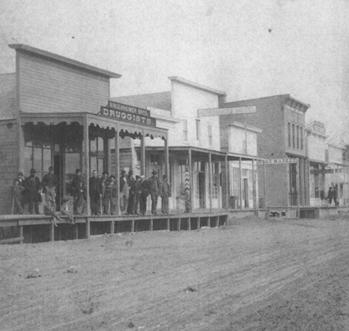
1883 East Main St (Merchants Hotel in center) Herman Yunck, Henry's younger brother, was born in 1854 in Richmond, MN. He moved to Mandan in 1881 and worked for D.R. Taylor (druggist) and the NP Railway. He was also employed on various riverboats for several years before operating a saloon owned by Henry. Henry died in April 1884. Herman married his brother's widow Philomena in 1886 and continued to operate the hotel with her. Together, they raised a total of six of Philomena's seven children. Herman was a charter member of the Mandan volunteer fire department; running the Hook and Ladder Company. He died on September 23, 1913. Pallbearers at his funeral included early city leaders including D.R. Taylor, Charles Wyman, John Foran, Pat Tobin, H. L. Henke and George Bingenheimer.
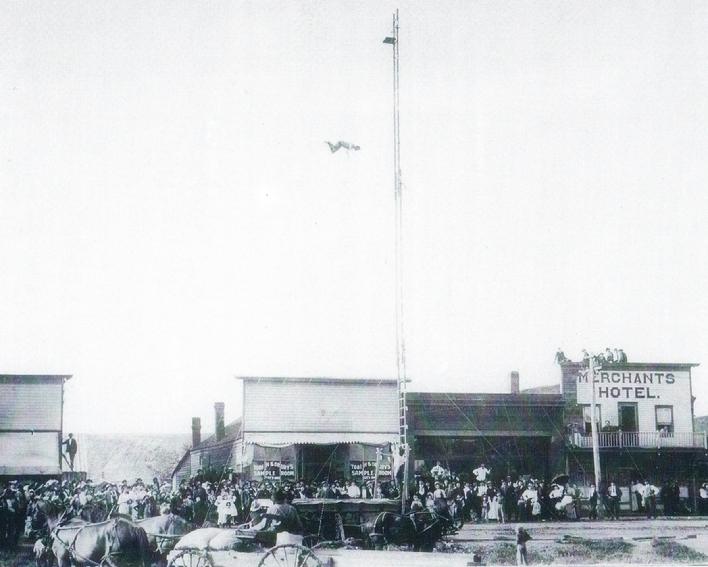
Undated Photo of Acrobatic Troop Performing on East Main Street (Merchants Hotel on right)
The building's operation converted to a boarding house in 1920. Polish immigrant Emil Block moved over from Bismarck, married daughter Willamina, and opened a first-class tailor shop in the front. Philomena Yunck continued to live in the building with her daughter (also referred to as "Minnie") and son-in-law until her death in 1925. After Emil Block retired from his tailor business in 1953, the space was taken over as "Seebs Shoe Repair" and finally operated as Ray's Bootery. In February 1965, firefighters battled for 3 hours to extinguish a major fire at the site. A family member was rescued by firefighters in the blaze. The fire started in the basement, and quickly spread to both adjacent commercial buildings due to high winds. At the time, it was home to Ray's Bootery, owned and operated by Ray Mosbrucker. Other businesses involved in the fire included Seeb's Shoe Repair and the vacant / former Friesz Grocery building.
The Society would like to thank Laine Pope for sharing information on her great grandparents with us.
Copy-edited article
The Merchants Hotel was among Mandan's earliest hotels. Built by Henry and Philomena Yunck, it opened in January 1880 at 112 East Main Street and operated until 1920. The hotel stood between the early railroad depot and the Emerson Institute, later expanded as the Opera House. After the railroad opened a larger depot three blocks west in 1883, the Merchants primarily served railroad workers and immigrants.
Henry and Philomena Yunck moved with their two-year-old daughter, Marie, to Bismarck, Dakota Territory, in 1878. They lived at the steamboat landing and operated a boardinghouse. Philomena prepared meals for the bridge-construction crew, while Henry worked as a laborer at the landing. In 1879, the couple and their children, now including son Joseph, moved across the river to Mandan and opened the hotel the following January.
Philomena became known for her meals. A ten-cent breakfast included hotcakes, sausage or bacon, fruit, and unlimited coffee; dinners cost no more than 65 cents. She prepared meals for the Marquis de Morès while he was jailed behind the hotel awaiting trial for murder. Chief Si Tanka—also known as Spotted Elk or Big Foot—frequently dined with the Yuncks while traveling to and from Cannonball. Theodore Roosevelt was a familiar figure at the hotel during early-1880s trips between Bismarck and Medora, when he stopped to hunt ducks with friends. Grover Cleveland also appears in the 1884 hotel register.
Countless immigrants relocating to Dakota Territory stayed without registering. The Yuncks often provided them free meals and lodging, eventually erecting a separate building at the rear of the property for that purpose.
Herman Yunck, Henry's younger brother, was born in Richmond, Minnesota, in 1854. He moved to Mandan in 1881 and worked for druggist D. R. Taylor and the Northern Pacific Railway. After several years aboard riverboats, he operated a saloon owned by Henry.
Henry died in April 1884. Herman married Philomena in 1886 and continued operating the hotel with her. Together, they raised six of Philomena's seven children. Herman was a charter member of the Mandan volunteer fire department and ran its Hook and Ladder Company. He died September 23, 1913.
The hotel became a boardinghouse in 1920. Polish immigrant Emil Block moved from Bismarck, married the Yuncks' daughter Willamina—also called Minnie—and opened a tailor shop in front. Philomena lived with her daughter and son-in-law until her death in 1925. After Block retired in 1953, Seeb's Shoe Repair occupied the shop, followed by Ray's Bootery.
In February 1965, firefighters spent three hours battling a major fire that began in the basement and spread in high winds to both adjacent commercial buildings. Firefighters rescued a family member. At the time, Ray Mosbrucker owned and operated Ray's Bootery. Seeb's Shoe Repair and the vacant former Friesz Grocery building were also involved in the fire.
The Society thanks Laine Pope for sharing information about her great-grandparents.