Original article
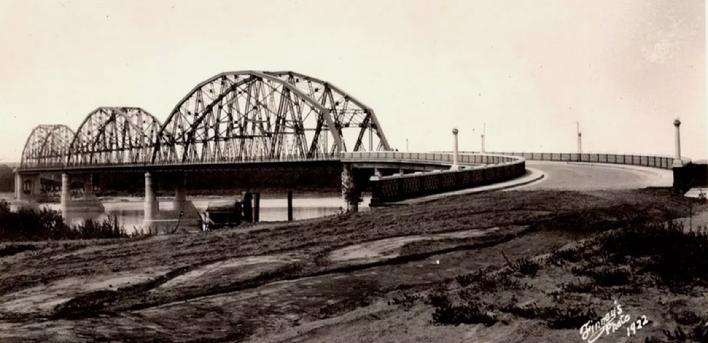
North Dakota Memorial Bridge in 1922 (Looking NW)
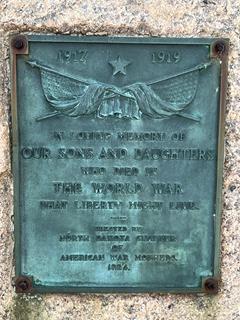
The North Dakota Memorial Bridge (later redesignated as the ND Liberty Memorial Bridge) was the first automotive bridge to span the Missouri River in North Dakota. Located on a highway designated as State Highway 6 in 1922 (designated as US Highway 10 in 1926), it was dedicated to the young men and women who served and died in World War I. Two boulders, taken from North Dakota prairies, placed at each end by the ND Chapter of the American War Mothers, hold plaques honoring their sons and daughters and were installed in 1924.The bridge boasts Warren-Turner design style trusses spanning 200 feet above the bottom of the lowest pier. Eight thousand rivets were driven into these trusses during their construction.
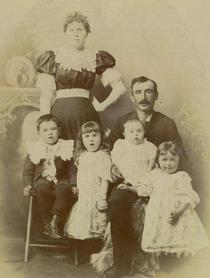
David Carey, his wife and four children arrived here in 1879. John McGinley rowed them across the Missouri River in a skiff in the middle of a heavy wind storm and they almost lost their life during the crossing. Mr. Carey had originally moved from Illinois to get work on construction of the Northern Pacific Railway bridge. He and his family almost lost their life during their first river crossing. He helped to build the first railroad bridge across the Missouri in North Dakota. So when the bridge was completed, the 86-year-old man made it a point, despite a wait for many hours, to be the first to cross it in an automobile. He would remark, "I am thankful I lived to see this day."
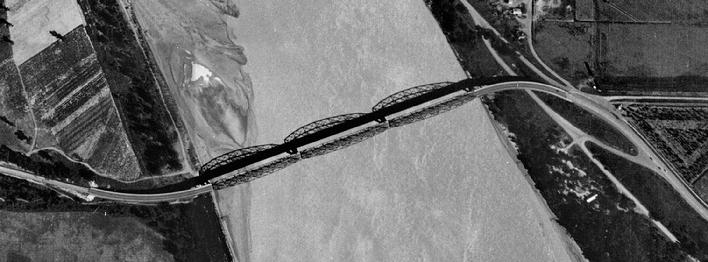
Aerial Photograph showing gravel roads on each side of paved bridge approaches (Photo Date 1933 17Aug)
The concrete approaches, girded on either side by North Dakota made brick, lead to the bridge; the one on the Bismarck side being 400 feet long but the Mandan side extends 625 feet. The main bridge deck and original approaches are 26 feet 6 inches feet wide supplemented by pedestrial walkways 4 feet 4 inches wide. The base of the eastern river pier is abouth 41 feet below normal water level and 101 feet below the roadway. The base of the western river pier is approximately 74 fee below water level and 134 feet below the road deck.The open well method was used in the pier construction. Workforce peaked at 250 with crews working day and night. Twice during the preliminary work on the bridge the construction trestle was torn out, once by ice and once by an unusually high June rise in the river level. Construction was begun in 1920 and a three-day dedication event held in September 1922. The total cost of the $1,358,000 ($23.5 million 2024$) bridge was born jointly by the Federal Government, the State of North Dakota, Morton and Burleigh Counties.
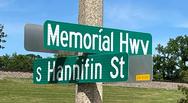
<Click to Enlarge> The bridge connected Mandan and Bismarck on as ND State Highway 6. For the first 2 years of operation, this road which stretched for 4 miles in the rural area between from Mandan's east Main Street to the intersection of Bismarck's Front Avenue and Hannifin Street. At that time, Bismarck's west Main Avenue was connected to the intersection by a 3-block long dogleg road segment which passed north to south under the railroad's viaduct to that intersection. In 1924, construction was completed to to upgrade it to a 2-lane concrete surface; and on May 30, 2025 (i.e., Memorial Day), the roadway to and from the bridge was redesignated as Memorial Highway, to honor the men and women who gave their life in service to their nation.
Construction of a 4-lane replacement bridge was started in 2006 after the stone piers began to deteriorate as the salt compounds used to remove the ice and snow from the bridge deck corroded the grout. The new Liberty Memorial Bridge, dedicated on November 11, 2008, honors all veterans who gave their life in service to their country. The original bridge was demolished with explosive charges and removed in pieces from the river bed. Several additional efforts to remove enough of the underwater original structure were required to adequately assure safe passage of marine traffic.
Note: The direct connection to the west end of Bismarck's Main Avenue was not installed until 1959. A viaduct was installed 200 feet southeast of the previous at-grade rail crossing to allow a straight out paved extensions from both Bismarck's Main & Rosser Avenues to allow the railroad tracks to pass over and continue north away from the car traffic.
Previously, traffic east of the bridge was largely on Memorial Highway (i.e., West Front Avenue) with access to Main Avenue via a dog-legged road and under-track viaduct from the Main Avenue at Washington Street to Front Avenue and Hannifin Street. The dogleg viaduct was eliminated as part of the 1994 Washington Street Reconstruction Project as new bridges were installed for Main Avenue and the railroad tracks.
Copy-edited article
The North Dakota Memorial Bridge, later renamed the North Dakota Liberty Memorial Bridge, was the first automobile bridge across the Missouri River in North Dakota. It carried State Highway 6 beginning in 1922 and U.S. Highway 10 beginning in 1926. The bridge honored the men and women who served and died in World War I. In 1924, the North Dakota chapter of American War Mothers installed prairie boulders bearing memorial plaques at each end.
The structure used Warren-Turner trusses that spanned 200 feet above the bottom of the lowest pier. Workers drove 8,000 rivets into the trusses.
David Carey, his wife, and their four children arrived in 1879. John McGinley rowed them across the Missouri River in a skiff during a severe windstorm, and they nearly died. Carey had moved from Illinois to work on the Northern Pacific Railway bridge and helped build North Dakota's first railroad bridge across the Missouri.
When the automobile bridge opened, the 86-year-old Carey waited for hours so he could be the first person to cross it by car. “I am thankful I lived to see this day,” he said.
Concrete approaches lined with North Dakota-made brick extended 400 feet on the Bismarck side and 625 feet on the Mandan side. The bridge deck and approaches were 26 feet 6 inches wide, with pedestrian walkways 4 feet 4 inches wide. The eastern river pier extended about 41 feet below normal water level and 101 feet below the roadway. The western pier extended about 74 feet below the water and 134 feet below the deck.
Crews used the open-well method to construct the piers. Employment peaked at 250, with work continuing day and night. Ice and an unusually high June river rise each destroyed the temporary construction trestle once. Construction began in 1920, and a three-day dedication was held in September 1922. The $1,358,000 (about $21,825,000 in 2025 dollars) cost was shared by the federal government, North Dakota, and Morton and Burleigh counties.
The bridge initially connected Mandan and Bismarck as part of State Highway 6. The four-mile rural roadway ran from East Main Street in Mandan to Front Avenue and Hannifin Street in Bismarck. Bismarck's West Main Avenue reached that intersection through a three-block dogleg beneath a railroad viaduct. The route was paved with two lanes of concrete in 1924 and renamed Memorial Highway on May 30, 1925, in honor of Americans who died in military service.
Construction of a four-lane replacement began in 2006 after deicing salts corroded grout in the original stone piers. The new Liberty Memorial Bridge, dedicated November 11, 2008, honors all veterans who died in service. Explosive charges demolished the original bridge, which was removed from the riverbed in sections. Several additional efforts were needed to remove enough submerged material for safe boat passage.
A direct connection to the western end of Bismarck's Main Avenue opened in 1959. A viaduct about 200 feet southeast of the former grade crossing allowed Main and Rosser avenues to extend directly west beneath the railroad tracks.
Before 1959, most traffic east of the bridge followed Memorial Highway—West Front Avenue—and reached Main Avenue through the dogleg road and viaduct between Washington and Hannifin streets. The dogleg was eliminated during the 1994 Washington Street reconstruction, when new bridges were installed for Main Avenue and the railroad.