Original article
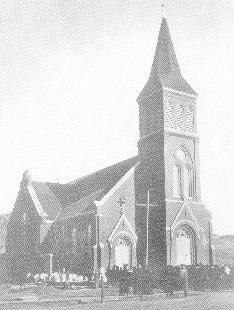
St. Joseph Catholic Church is significant for both its architecture and its history. Designed in Romanesque style, Milwaukee Wisconsin architect Anton Dohmen designed a total of 5 North Dakota churches including St. Mary's at Assumption Abbey in Richardton, ND. He also submitted the original design for Bismarck's Cathedral of the Holy Ghost, only to have it later rejected.Mandan's first Mass was held in 1879 at the Linnehan residence and celebrated by Father Valentine Sommereisen. The parish was organized in 1881 and steps were taken to secure land for a church building in the midst of the "Catholic settlement" within the city. That fall, active work was begun on the building situated on the corner of Stark Avenue (now Collins Avenue) and 3rd Street.
A wood building was completed in October of 1882 and was intended as a combined Catholic school and church. Owing to the size of the congregation, the original plan had to be modified. The Reverend Father Cassidy - previously of Yankton, DT - had been connected with the parish since its organization. In 1884, he was reported to be residing in a rectory which had been added to the original church building. Statues of the Virgin Mary and St. Joseph were gifted to the congregation from friends of Father Collins in New York in February 1897. Stations of the Cross were added several months later.Although originally a heavily Irish-influenced congregation, by 1892 German's from the Ukranine began arriving in Morton County. Barely a decade after the first St. Joseph's church was completed, church records indicate requests for a German priest and the use of German in services in confirmation instruction. The selection of the German-born Anton Dohmen by the Irish-born priest to design the larger, replacement church may have been an attempt to address the desire for more German influences in the operation of the parish.
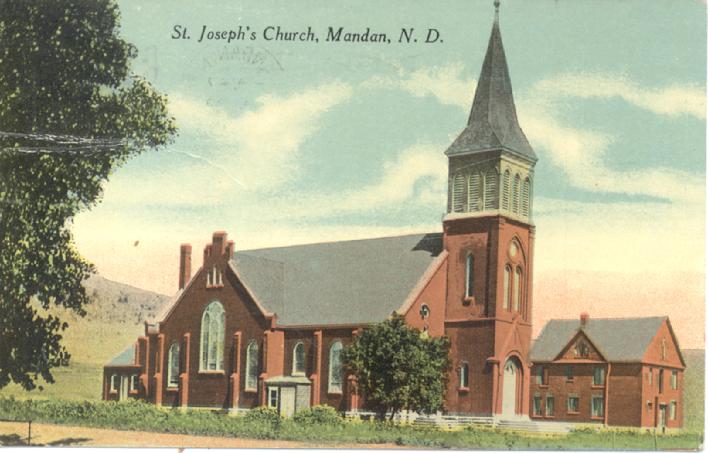
The cornerstone was laid in April 1904. A tin box beneath it contains relics from Lourdes, Rome, Bethlehem, Jerusalem, Mount of Olives and the River Jordan. The construction of the current church building was led by Father Daniel Collins who personally loaned $13,500 toward the $40,000 construction cost. Upon his death in 1909, he was interred in a vault located in the basement.
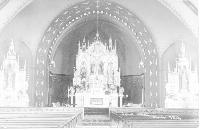
The church was dedicated in November 1904 by Bishop John Shanley, North Dakota's first Catholic bishop The church seats 725 and has a tower/steeple with a height of 114 feet. The original interior was very ornate, making extensive use of stencils to decorate and define the vaulted ceiling arches. The decoration was very similar to the churches the immigrants would have known in Europe.
In June 1921, the outdoor statue "Jesus Blessing" was added to the grounds. A special mass and dedication ceremony was held featuring a 300-member children's choir and presided over by Bishop Wehrie. The statue was funded church's rosary society, the St. Mary's Society with major donations from 2 local residents. The church building was originally constructed originally with native rock, Kosota stone facings and Menominee brick from Wisconsin. A narthex was added to the front in 1974 to create a "gathering space" consistent with new Catholic Church design criteria subsequent to Vatican II.The original stained glass windows, most likely designed by Karl Riemann a Milwaukee artist in collaboration with the architect, remain. Their designs are depict "devotional" rather than traditional "narrative" storytelling themes which makes them very unique. The windows honor saints and many are dedicated to the pioneer priests from throughout the region.
Copy-edited article
St. Joseph Catholic Church is significant for both its architecture and its history. Milwaukee architect Anton Dohmen designed the church in the Romanesque style. He designed five North Dakota churches, including St. Mary's Church at Assumption Abbey in Richardton. Dohmen also submitted the original design for Bismarck's Cathedral of the Holy Spirit, although it was later rejected.
Mandan's first Mass was celebrated in 1879 by Father Valentine Sommereisen at the Linnehan residence. The parish was organized in 1881 and secured land for a church within the city's "Catholic settlement." Construction began that fall at Stark Avenue, now Collins Avenue, and Third Street.
A wooden building intended to serve as both church and school was completed in October 1882, although the size of the congregation required changes to the original plan. Father Cassidy, previously of Yankton, Dakota Territory, had been associated with the parish since its organization. By 1884, he reportedly lived in a rectory added to the original church. Friends of Father Collins in New York gave statues of the Virgin Mary and St. Joseph to the congregation in February 1897. Stations of the Cross were added several months later.
The congregation was initially heavily influenced by Irish members. By 1892, Germans from Ukraine had begun arriving in Morton County. Barely a decade after the first St. Joseph's Church was completed, parish records included requests for a German priest and for German to be used in services and confirmation instruction. The Irish-born priest's selection of German-born Anton Dohmen to design a larger replacement church may have been an attempt to address the desire for greater German influence in the parish.
The cornerstone was laid in April 1904. A tin box beneath it contains relics from Lourdes, Rome, Bethlehem, Jerusalem, the Mount of Olives, and the Jordan River. Father Daniel Collins led construction of the current church and personally loaned $13,500 toward its $40,000 cost. After his death in 1909, he was interred in a basement vault.
The church was dedicated in November 1904 by Bishop John Shanley, North Dakota's first Catholic bishop. It seats 725, and its tower and steeple rise 114 feet. The ornate original interior used extensive stenciling to decorate and define the vaulted ceiling arches, resembling churches familiar to European immigrants.
The outdoor statue "Jesus Blessing" was added to the grounds in June 1921. Bishop Wehrle presided over a special Mass and dedication ceremony featuring a 300-member children's choir. The church's rosary society, St. Mary's Society, funded the statue with major donations from two local residents.
The church was constructed with native rock, Kasota stone facing, and Menominee brick from Wisconsin. A narthex was added in 1974 to provide a gathering space consistent with Catholic church design after the Second Vatican Council. The original stained-glass windows remain. They were most likely designed by Milwaukee artist Karl Riemann in collaboration with Dohmen. Their unusual devotional designs honor saints, and many are dedicated to pioneer priests from throughout the region.