Original article
On a whim, 24-year-old college dropout Peter Wolf Toth (rhymes with "oath") stopped along the California shore and began to carve a giant head into a seaside cliff. Upon his return the following day to the site, a crowd had gathered. The local paper characterized the partially complete sculpture as an Indianhead. In a 1989 interview, Toth admitted, “Subconsciously I may have carved an Indian. I was always interested in these noble people.” He eventually returned to his adopted hometown of Akron, Ohio and carved a second Indianhead in a dead elm tree stump a local city park. Toth eventually realized his life's mission: to call attention to the history of Native Americans whose plight seemed to parallel his early childhood. "I will make a sculpture of an Indian, to honor them in each of the fifty states." He dubbed his effort as the "Trail of Whispering Giants."
With the exception of his first sculpture in California, carvings were done in local woods. Claiming the figurine was a composite image of the eight North Dakota tribes, it resembles his other statues with a craggy, Methuselah-ancient look. After abandoning his initial effort on a tree in Jaycee Park, found to be hollow and in poor condition, the Helbling family donated a healthy cottonwood tree nearby. Cottonwood had been used by the Mandan Indians to build their earth lodges. The statue would later be treated with wood preservatives to protect it against the weather.
The sculpture was formally dedicated on November 24, 1981 and given to the people of North Dakota. Originally intended to be installed at the Heritage Center in Bismarck, Toth was put off by the time delay and red tape associated with selection of a state-owned site. He agreed to a south Mandan location after the Helbling Family donated the corner of the parking lot at one of their businesses, with the plan to donate the land to the local Park District. Toth liked the location; on the route to Standing Rock Indian Reservation and near the ND Highway 1806 Sitting Bull Bridge across the Heart River and out to the Mandan Slant Indian Village at Ft. Lincoln State Park. Toth wanted locations with high visibility and full access for the public.
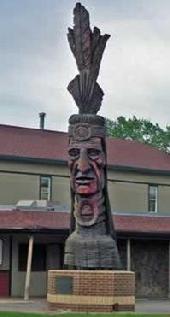
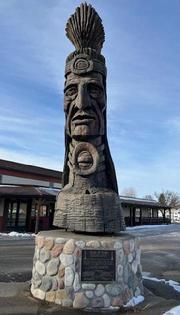
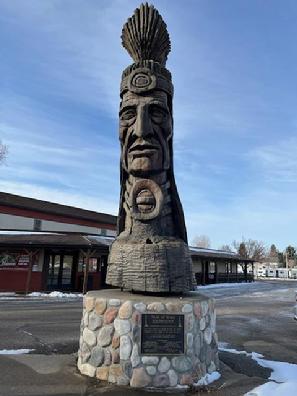
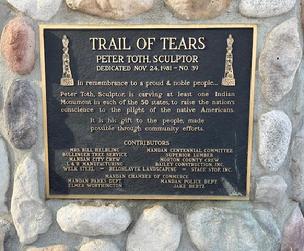
Mandan’s statue, 39th in the series, was originally 25 feet high (including 3.5 foot high base) with a full feather in the center rear of the head dress. The octagon-shaped poured concrete base was initially covered with a brick veneer. But in 2013, the base was struck by a car in an accident, ripping the brick covering off the base. The statue's plinth was reworked in 2014 by the City of Mandan staff to its current round shape and its veneer replaced with a stacked stone design. The dedication plaque was also refurbished by L&H Manufacturing and reinstalled.
In 2020, most of the tall center head dress feather fell off after a storm. Wood rot in the base of the main feather was noted; possibly damaged in 2012 incident. The rotted wood was removed and the entire carving was resealed by Mandan city staff. The repair leaves only a spray-shaped bunting to adorn the headband and the stub of the former rear feather. The carving now stands just short of 20 feet including the base.
Born in Hungary, Peter Toth's family was forced to relocate to Poland. Then at age 9, his family fled again, this time by foot and train, to Yugoslavia during the rebellion in 1956. They moved from one refugee camp to another. The family eventually immigrated to Ohio. His early life paralleled that of many Native Americans with multiple relocations, subjected to violence and repression. "My monuments are made to remind people of the contributions of the Indians of this country," Toth said, "Statues to honor the plight of the Native Peoples of North America." He grew up watching his father carve wood. Supplemented with some formal training in college (he considers himself a self-taught artist) and using mostly just a hammer and chisel, Toth created the sculptures. He based their physical features and adornments in consultation with regional tribal members. "[It] is my concept of the Indians of ... the area ... [I] visualize an Indian within the log. It is a composite of all the native people of the state."
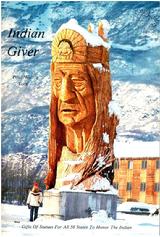
Costs associated with the wood substrate and the carving's base were typically donated locally. Toth accepted no money for his labors. His intent was to donate the monuments as a gift to his adopted country. He lived on earnings from odd jobs and the sale of small carved objects he would work on in the evenings. Sometimes city governments, Park Departments, Chambers of Commerce and private individuals would assist by covering his living expenses or by providing needed materials and services. He also wrote a book "Indian Giver" to chronicle significant aspects of his life and efforts to complete the "Trail of Whispering Giants." The book was periodically updated and reissued to include the entire mission finishing with the 4th edition.
After completing the Mandan statue, Peter Toth and his wife Kathy traveled to Alaska to begin his next carving. He completed his initial goal to erect one carving in all 50 states in May 1989. The Polynesian head in Hawaii was actually statue number 58, as a few states had multiple statues and Canada had already received two. The series ended with a total of 73 monuments across the United States and the Canadian provinces of Manitoba and Ontario. He also made a 74th carving in his native country of Hungary to honor their King Stephen I.
The Mandan Historical Society appreciates the assistance from Mayor Tim Helbling who provided photos and information about the 2013 damage and the City of Mandan's involvement in maintaining the monument.
Copy-edited article
On a whim, 24-year-old college dropout Peter Wolf Toth—whose surname rhymes with "oath"—stopped along the California coast and began carving a giant head into a seaside cliff. When he returned the next day, a crowd had gathered. A local newspaper characterized the unfinished sculpture as an Indian head. In a 1989 interview, Toth acknowledged that he may have carved one subconsciously because he had always been interested in Native people.
After returning to his adopted hometown of Akron, Ohio, Toth carved a second head in the stump of a dead elm tree in a city park. He eventually conceived a mission to create a Native American sculpture in each state, calling the project the Trail of the Whispering Giants. He intended the works to draw attention to Native American history and to experiences of displacement that he felt paralleled his own childhood.
Except for his first sculpture in California, Toth carved the monuments from local wood. He described the Mandan figure as a composite representing North Dakota's Native nations. After abandoning an initial attempt using a hollow, deteriorated tree in Jaycee Park, the Helbling family donated a healthy cottonwood nearby. The Mandan people had used cottonwood in building earthlodges. The completed sculpture was later treated with preservatives to protect it from the weather.
The sculpture was formally dedicated and presented to the people of North Dakota on November 24, 1981. Toth originally intended to place it at the Heritage Center in Bismarck, but delays associated with selecting a state-owned site led him to accept a location in southern Mandan. The Helbling family donated a corner of a business parking lot with the intention of transferring the land to the local park district.
Toth favored the publicly accessible location along the route to the Standing Rock Indian Reservation, near the Highway 1806 bridge across the Heart River and the Mandan village at Fort Abraham Lincoln State Park.
Mandan's sculpture, the 39th in the series, originally stood 25 feet high, including its 3.5-foot base, and had a full feather at the center rear of its headdress. The octagonal concrete base was originally faced with brick. A vehicle struck it in 2013 and tore away the veneer. City staff rebuilt the plinth in a round form in 2014 and covered it with stacked stone. L&H Manufacturing refurbished and reinstalled the dedication plaque.
Most of the tall center feather fell during a storm in 2020. Rot was found at its base, possibly related to earlier damage. Mandan city staff removed the deteriorated wood and resealed the carving. The sculpture now retains a spray-shaped ornament on the headband and a stub of the former rear feather. Including its base, it stands just under 20 feet tall.
Toth was born in Hungary. His family was forced to relocate to Poland and, when he was nine, fled by foot and train to Yugoslavia during the 1956 uprising. They moved among refugee camps before immigrating to Ohio. He later compared those repeated relocations and experiences of violence and repression with those of many Native Americans.
Toth grew up watching his father carve wood. With some college training, although he considered himself self-taught, he created his sculptures primarily with a hammer and chisel. He consulted regional tribal members when developing their features and adornments, while describing each figure as his own composite conception of the area's Native people.
Local donors typically provided the wood and materials for each monument's base. Toth accepted no payment for his labor, intending the sculptures as gifts to his adopted country. He supported himself through odd jobs and the sale of small carvings made in the evenings. Municipal governments, park departments, chambers of commerce, and private individuals sometimes provided living expenses, materials, or services. He chronicled his life and the project in the book Indian Giver, periodically updating it through a fourth edition.
After completing the Mandan sculpture, Toth and his wife, Kathy, traveled to Alaska for his next carving. He completed his goal of placing a monument in all 50 states in May 1989. The Polynesian head in Hawaii was number 58 because several states had multiple statues and Canada had already received two. The series ultimately included 73 monuments in the United States and the Canadian provinces of Manitoba and Ontario. Toth carved a 74th monument in Hungary to honor King Stephen I.
The Mandan Historical Society acknowledges Mayor Tim Helbling, who provided photographs and information about the 2013 damage and the City of Mandan's maintenance of the monument.